

home·bod·y
/ˈhōmˌbädē/
noun
INFORMAL•NORTH AMERICAN
a person who likes to stay at home, especially one who is perceived as unadventurous.
"since his marriage, Brett has become a homebody"
On our first two road trips, documented in Open Road: a Midlife Memoir of Travel through the National Parks, I became deeply weary and existentially anxious with all of the transitions in and out of tents, lodges, campsites, vans and motels.
I’m a homebody. Denying it made travel more unpleasant in the end.
By buying a trailer, Mike and I hoped that we could enjoy a long road trip camping while avoiding the emotionally taxing price tag of disequilibrium as we constantly adjusted to new surroundings. This was long-winded way of saying that the trailer would become our home, and this homebody could be “home” wherever we went.
And to be comfy in the trailer, I needed my beanbag.
Mike thought the beanbag was ridiculously bulky. Every inch of space inside was valuable real estate.
“And why did you have to get a bright blue one?” He surveyed my precious, high density foam, Kickstarter-funded, ergonomic “Moon Pod” with disdain.
This was no ordinary beanbag. I did not admit how much it cost me, although it might have increased Mike’s respect for the “big blue blob” if I had.
“I’m not going without it,” I said with dignity. “It’s an important zero gravity relaxation device I use every day.”
In a display of passive resistance, Mike neglected to pack it into the admittedly completely full SUV as we prepared to depart for our first long trip, a three-week trek to Yellowstone. The Moon Pod sat forlornly next to the stairs like a hobo’s big bag of laundry hoping for a ride on a cold and windy night.
I locked the house, checked all the doors, put our little dog Koa on his leash, and grabbed the beanbag. I toted it up the stairs to the vehicle. “I told you, I’m not leaving without it.”
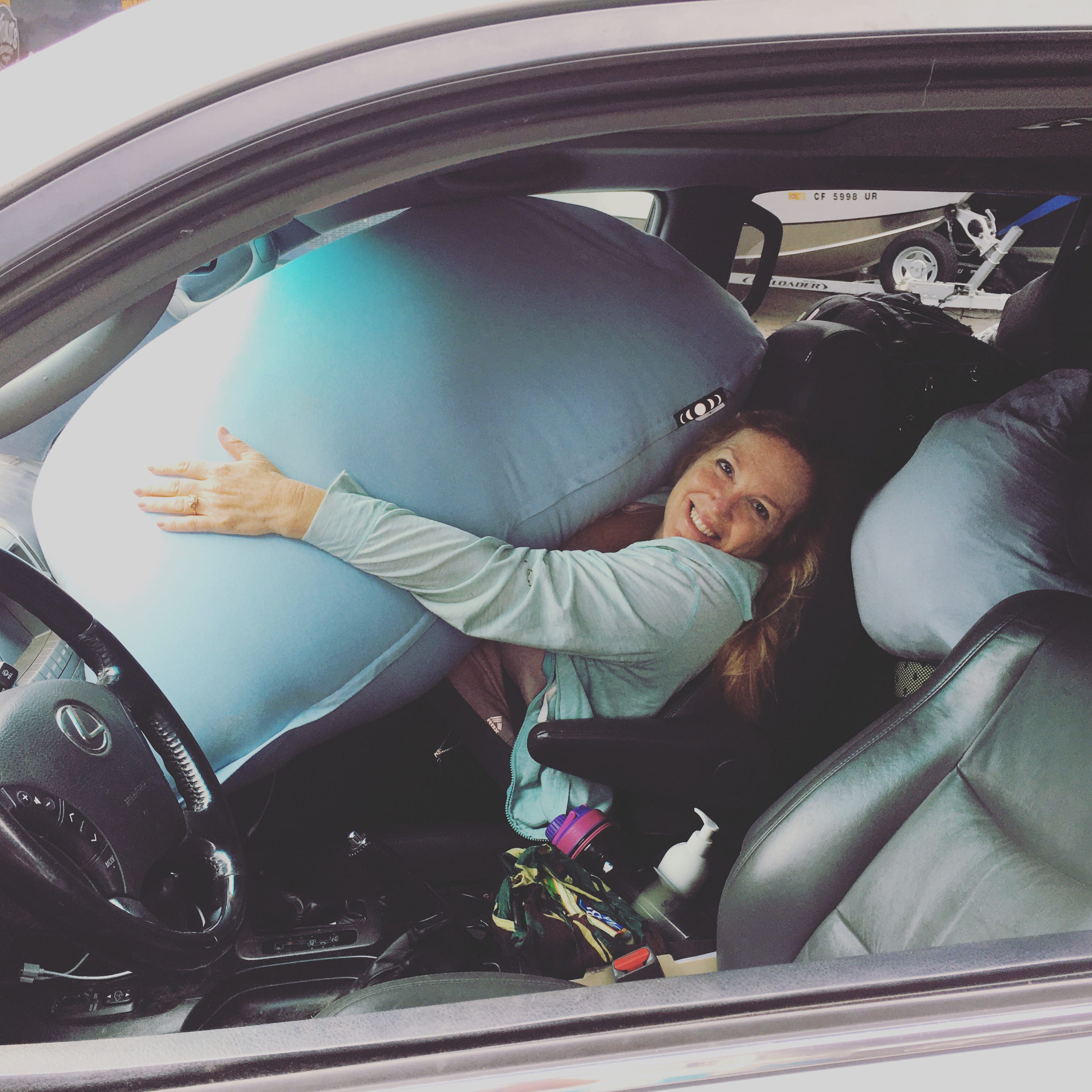
Mike blew out an aggrieved sigh as I wedged our dog in at my feet, slid myself in, then drew the gigantic beanbag on top of me. Bulging, squishy blue fabric engulfed me and the entire passenger area, including the windscreen and dashboard, covering me from the car’s roof to my knees. Koa whimpered from the footwell, but I shushed him. There was plenty of air for him down there; I, however, had to roll down my window to breathe.
“I can’t see around that thing,” Mike complained. “It’s not safe.”
“I’m taking it.” I firmed my jaw. The Moon Pod was my equivalent of a comforting rocking chair, and we were going on the road for three weeks. I needed it.
Mike got out, walked around, pulled the beanbag off me, carried it to the back of the SUV, and jammed it up into the open space under his small boat, already tied onto the roof. “It’ll be fine up there until we get to the trailer park.”
We kept the camper parked at a facility fifteen miles or so away. He got back in and we took off, frazzled from packing and the effort of leaving the house. Whenever we start a new trip, Mike has a “get ‘er done” internal engine that rolls hard and revs up my anxiety. In response I get stubborn, nervous and jumpy. That dances a jig on his last nerve, so departures were frequently scratchy in the relationship department.
Loaded to the axles and all the way to the top of the roof, we rocketed along the a narrow, winding road through the forest, headed toward the RV storage facility. I began to get car sick. “Can you please slow down?”
Mike glanced at my green face and took his foot off the gas. Other cars piled up behind us, probably commuters, so he pulled over to let them pass. A young man in a purple sports car drew abreast of us.
“What does this guy want?” Mike grumped. He rolled down his window.
The young man threw a thumb back over his shoulder. “You lost your giant blue pillow about three miles back down the road.” He didn’t bother to hide his grin as he peeled away.
Mike looked at me, clearly hoping to leave my beanbag behind.
“No. We have to go back and get it!” I exclaimed, horrified. “You obviously didn’t secure it very well under the boat!”
Mike didn’t bother to reply. He spun the SUV around and we drove entirely too fast for my churning stomach back through the woods, scanning the shoulders. Sure enough, three miles back, the beanbag had rolled into the bushes. It lay sad and dirty in the weeds, a giant blue marshmallow.
Mike pulled the vehicle over, got out, retrieved the beanbag and resumed trying to stuff it up under the boat. This idea hadn’t worked the first time, and wasn’t going to work a second time. I got out to intervene, and clapped my hands to my face. “Oh no!” The beanbag must have hung down against the back of the SUV for some distance, because one end of it had scorched and melted into a solid plastic blob by resting against the exhaust pipe. “My poor beanbag!”
“Since you love it so much, you can hold it in your lap after all,” Mike said. “I can’t find a way to secure it on top.”
“That’s fine. No problem.” Clutching the maimed beanbag, I got into the front seat again. Koa cowered between my feet in the wheel well as I squeezed the big blue blob in on top of us and somehow closed the door. The thing covered us entirely from gearshift to window, but it was quite pleasant to hug, even though melted and dirty. I shut my eyes and relaxed now that it was right where it should be.
We drove all the way to the RV place engulfed in the Moon Pod.
I finally ventured, “At some point, we’re going to think this was funny.”
Mike rolled his eyes; they were the same shade as the beanbag, and that’s the real reason I’d ordered it in Nordic Blue.
Mike tried to get me involved in the planning of our trip, which we scheduled during his job’s vacation time in June. He printed out maps and itineraries, laid them on my desk, and poked them with a forefinger. “Look at this. This is where we’re going.”
I said, “uh-huh. Okay.”
Truth was, other than knowing our ultimate destinations (Yellowstone, then Grand Teton, and finally a brief stop Yosemite on the way home) some part of me preferred to let each day unfold, unknown. I’ve never really understood my resistance to the planning stage; perhaps it was a way of managing my anxiety, because there’s a lot about trailer camping that scares the crap out of me.
Here are a few of my least-favorite things:
Steep roads lacking shoulders that can easily catch a trailer’s tire and pull you off a cliff.
The prospect of breakdowns or running out of gas in the wilderness.
Bears.
The way the trailer swings behind the truck with pendulum g-forces and threatens to pull you into another lane, where giant big rigs snarl by at eighty miles an hour, sucking us into their wake and rattling our windows.
Getting locked outside the vehicle or trailer.
Gas station bathroom door handles.
The random, unpredictable behavior of other drivers.
People with quads, guns, and mean dogs at the campgrounds.
I’ve come to accept that danger and unpleasantness are the spices of adventure, however; any activity without risk didn’t truly fulfill that nagging lust that pulled us into these journeys.
Our first drive day after the Moon Pod incident ended at a park called Fallen Leaf Lake in South Lake Tahoe, California. Tired, near dark, we pulled into a mercifully easy parking spot between two pines and decided not to unhitch. We’d be getting on the road early the next day, heading for mountaintop lake in Nevada close to the border of Montana.
The night soon grew chilly, but the Retro’s heater refused to turn on. We bundled up in extra clothing and blankets and managed to sleep okay through the night. A heater not working isn’t ideal, especially when heading into more elevations. Mike determined to fix the thing before we got on the road to Nevada.
After breakfast, he lay on the floor of the trailer and turned on his side to access the low port of the wall-mounted heater. He scattered tools all around and muttered curses as he took apart the heater and cleaned out the ducting. “So much for being brand new,” he said. “They never cleaned this unit at the factory. It’s all clogged up.”
I squatted beside him. “What can I do?”
“Go have a bathe in the lake,” he said. “I’ll join you when I fix it.”
Mike, when he’s on a mission, can be quite focused. I’ve learned over thirty-something years that my help is generally unwanted and usually not effective, anyway. So, feeling mildly guilty but excited, I set off for the lake through the sunny woods with Koa. I wore a swimsuit, pareau wrap, and slippers, fine for the warm day. I carried my journal, a towel, and a bottle of Dr. Bronner’s Pure Castile Soap, as minty-fresh now as it was in the 1970’s when it was our family’s staple while jungle camping on Kauai.
The Retro was a heavy electricity and water user, and we were boondocking at this park, hence the necessity of a swim in lieu of a shower. Boondocking is when there are no outside hook-ups for electrical, sewage or water supplementation. That means that everything needs to be carefully rationed until tanks can be filled and dumped and batteries recharged.
I took my shower by swimming in lovely Fallen Leaf Lake, washing up with the biodegradable soap reminiscent of my childhood. The water was glass-clear with colored stones all over the bottom and the reflection of crags in the distance, and splashing my underarms briskly, I gave a chuckle that I was in my mid-fifties and still swimming outside and using Doc Bronner’s to clean up. Even with a trailer, we were camping—and that’s why l love it.
I swam out a good distance to enjoy the view, careful to keep my body in the sun-warmed top couple of feet of water. Koa frantically tried to reach me from the shore, eventually tugging loose his leash and splashing his way out to join me. A bad swimmer because of his long fur, our rescue dog was only content when I held him in my arms as we floated.
That was a glorious start to the day, but Mike never appeared as he said he would. I eventually walked back to camp to find that he had reassembled the heater. “It still won’t work,” he frowned. “But maybe when we get to our next destination, I can give it another go. Hopefully it won’t be too cold until I get it fixed.”
We closed up the trailer and got on the road, much later than we had intended, noon by the time we cleared South Lake Tahoe and headed up the long grade that led over the Sierras to Carson City and Reno, another hour beyond. We drove for many hours through flat desert spotted by sagebrush, the air softened by haze from California’s fires, burning early that year.
The miles passed easily under the spell of a terrific storyteller as we listened to an audiobook of Dana Stabenow’s Kate Shugak Mysteries, a series starring a tough Inuit female investigator and her dog in Alaska. Kate was crabbing on a trawler in tin this mystery of missing crew members, and the action was authentic and gripping. We immersed in the chilly environment of the Aleutian Islands even as we passed through heat-shimmering desert landscapes.
Seven p.m. rolled around when we finally approached that evening’s destination, Angel Lake, touted as an eight thousand, five-hundred-foot alpine gem that held hybrid fish called tiger trout.
When “Lady Google” told us we were twelve miles away, we were still in the desert flats and passing yet another beige-colored tiny town built around a gas station.
“There’s our turn-off.” Mike pointed. A battered sign pointed off to the left toward a lone, jutting peak that pierced the smoky sunset sky.
I glanced at the gas gauge worriedly. “We’re at only a quarter of a tank. I think we should turn around and fill up before we head into the wilderness.”
Our tow vehicle had been sucking fuel all day as we crossed seemingly flat desert areas; they were actually at an uphill slant and that was evident in the straining of the engine and the way our vehicle chugged fuel. Even so, our entire rig is fairly streamlined with Mike’s little boat lashed to the roof and my beanbag safely stowed in the trailer, out of the way under the bed.
Gassed up and ready to call it a day after ten hours of driving, we wound uphill toward Angel Lake. The mountain’s steep curves were gasp-worthy and there was no guardrail. I clung to the interior handle of the passenger door as if anything could save us if we tipped off the edge of one of the cliffs.
“Breathe,” Mike teased me. His grip on the wheel was sure and steadfast. The powerful SUV growled like a lioness as she roared from one thousand to eight thousand, five hundred feet of elevation in a mere ten miles—while towing two tons.
Angel Lake rested in the lap of the steep mountain’s triple peak like a translucent green gem, and it too was gasp-worthy.
After we parked the trailer, Mike and I stumbled through the dusk to stand on the boulder-strewn bank and take in the moon, giant tonight as a half-melted peppermint, gleaming above the water. Towering, striated mountains enfolded the enchanting tiny lake like hands cupping an offering. Trout rose on the water’s surface, creating circles that scattered the perfect reflection of moonlight and a scarf of stars.
Best of all, even at that elevation the night wasn’t cold; at nine p.m, I was still comfortable in a sleeveless shirt and shorts.
The heater not working was going to be okay.
(Thanks so much to you who are following along! If you liked the piece, please hit the little ❤️, it means so much to know you read it…)
….and since this is only for subscribers from here on out, I thank you again for your support! 🙏🏻
Toby you are wildly funny at every turn… I hope you know how much I enjoy your combo of human insight, brilliant ease with words and, yes, humor! More please… ! I love it.
You make a Moon Pod look like the most glamorous accessory there is! I want one!